

Aosta Valley Castles
Verrès Castle
The Verrès Castle stands on a rocky spur, dominating the whole village. The building, constructed in the 14th century, anticipates the architectural style that would become more widespread in the following centuries: it is in fact a single block, a cube of stone 30 metres on a side. The castle can be visited inside throughout the year.
Entrance
After passing through the gateway in the fortified walls, which is also accessible on horseback from the drawbridge, you come to the guardhouse opposite the castle entrance.
The entrance door leads into a hall defended by a machicolation concealed in the vault; a second door, formerly protected by a portcullis, gives access to the castle courtyard. Around this square room, the body of the building is arranged in a ring on three floors, connected by a monumental stone staircase set on rampant arches. The geometric regularity of the structure and the essentiality of the decoration, entrusted solely to details in green and white dressed stone, are in keeping with the military character of the building and also denote the excellence of the craftsmen who worked in Verrès.
Ground floor
On the ground floor there are two large symmetrical rooms occupying the entire east and west sides of the castle, while the kitchen is located to the south. The eastern room, probably originally used as an artillery store, is covered by a barrel vault. The western, pointed-vaulted armoury is of greater interest: it has two monumental chimneys with shaped jambs; the doubling of the walls and other indications that emerged during restoration testify to the overlapping of several construction campaigns.
First and second floors
The rooms on the first floor, reserved for the lords of the castle, are lit by elegant 14th-century-style mullioned windows with two lights, larger than those on the other floors. The large dining room is connected by a passageway to the master’s kitchen. This last room, with three large fireplaces, has a stone vault with multiple sails, rebuilt at the time of Renato di Challant, the only original covering still existing in the castle; also noteworthy is the fireplace on the north side, of exceptional dimensions and richly decorated with mouldings and pilasters.
On the second floor (which cannot be visited) are the service flats, connected by a wooden staircase to the machicolation floor.
Events
Every year the castle is the prestigious stage for the Historical Carnival verreziese, in which the epic deeds of Countess Caterina di Challant are re-enacted, amid history and legend.
Savoy Castle (Gressoney-Saint-Jean)
The Savoy Castle, owned by the royal family of the same name, is located in Belvedere and was the summer residence of Queen Margherita between 1904 and 1925. Leaving your car outside the gate, you can enjoy the magic of the fir tree path leading to the building, embellished with five pointed towers that give it the appearance of a fairytale castle. The interior is richly decorated with abundant wooden inlays and coffered ceilings, and an elegant staircase connects the first and second floors.
Ground floor
Al pianterreno, una volta indossati i calzari per preservare i pavimenti originali del maniero, gli ospiti accedono ad un vasto atrio a colonne ove è possibile osservare un altare smontabile usato per la celebrazione delle Messe durante i soggiorni della Sovrana a Gressoney. Si visita la sala da pranzo, dalla ricca decorazione dipinta sulle pareti, sul camino e sul soffitto e rivestita da una boiserie con intagli a pergamena in stile neogotico. Il percorso si sviluppa poi attraverso la veranda semicircolare che si affaccia sulla valle e prosegue verso la sala da gioco, con il biliardo originale ed i salottini di soggiorno.
Main floor
On the main floor, there is an elegant and majestic oak staircase carved with griffins and eagles that leads to the royal flats, preceded by an atrium on the ceiling of which can be read the inscription Hic manebimus optime.
First floor
The tour reaches the first floor via the spiral staircase inside the watchtower. In the room reserved for the spiritual father who followed the royal family on their holidays in Gressoney, there are several photographs on display showing the Queen and her entourage during their leisure time in the mountains.
Next we proceed to the flats of King Umberto I, where we can admire other curious period photographs. The Queen’s flat occupies the best position and is richly furnished with furniture in the eclectic style dear to her, partly coming from Villa Margherita, the residence that welcomed the Sovereign in the village in the years preceding the construction of the Castle; next to the bedroom you can see the bathroom, while on the opposite side, in the northern tower, there is a charming boudoir, with false drapes painted on the walls that recall the decoration of the baronial hall of the Issogne castle, and windows that allow you to contemplate the magnificent panorama of Monte Rosa and the entire valley. Finally, the room next to the Queen’s is dedicated to Crown Prince Umberto II.
Other castle rooms
The sundial, built on the façade in 1922, bears the words of good wishes already inscribed on a sundial in Cogne in 1915: Sit patriae aurea quaevis (“Let every hour be golden for the motherland”). Unfortunately, this wish would not be fulfilled by the dramatic events that took place in Italy that very year.
The kitchens, located in a building not far from the castle, are connected to the dining room by an underground Decauville.
The botanical garden, inaugurated in 1990 in the park at the foot of the manor, consists of rocky flowerbeds with botanical species typical of the Alpine environment.
Other outbuildings of the castle are Villa Belvedere, originally used as a guesthouse and royal gendarmerie, and the small house known as Romitaggio Carducci, dedicated to the poet who was a devoted admirer and singer of the Queen.
Issogne Castle
Issogne Castle is one of the most important castles in the Aosta Valley: it is a sumptuous stately home that still today boasts marvellous frescoes depicting scenes of Renaissance life, both in the external portico and in the reception and private rooms. The central courtyard houses the famous Pomegranate Fountain, made of wrought iron and a symbol of prosperity.
Structure
Entering the palace, are the courtyard, surrounded by buildings on the walls of which are portrayed the coats of arms of the Challant family and their relatives; passing the pomegranate fountain, one proceeds to the hallway decorated with fine lunettes depicting the guardhouse, the butcher’s and baker’s shop, the fruit and vegetable market, the tailor, the apothecary and the pizzicagnolo.
Then we proceed to visit the interior of the castle:
- on the ground floor: the dining room, the kitchen and the baronial room, where you can admire a fine stone fireplace with the Challant coat of arms on the hood, flanked by a lion and a griffin, paintings on the wooden beams of the ceiling and walls frescoed with landscapes, hunting scenes and the Judgement of Paris;
- on the first floor: the chapel, with finely decorated ogive vaults, frescoes on the walls and a Gothic altar in carved and gilded wood adorned with a Flemish triptych, and the Countess’ room, with a painted oratory;
- on the second floor: the room known as the “King of France’s room”, with its coffered ceiling decorated with lilies and a fireplace bearing the shield of the Valois dynasty on its hood, and the room known as the “Knights of St Maurice’s room” with its fine coffered ceiling on which the cross of this order is painted.
The ruins of the dovecote still stand a short distance from the castle.
Vittorio Avondo
Starting in autumn 2018, a flat dedicated to Vittorio Avondo, the illustrious owner of the Issogne manor, will be set up, enhancing and enriching the castle’s offer by highlighting its late 19th-century events with a series of panels, multimedia solutions and elements of poetic suggestion.
Born in Turin in 1836 and devoted to painting from a young age, Avondo is considered one of the best representatives of 19th-century Piedmontese landscape painting. After a period spent in Rome, painting landscapes of the Latium countryside inspired by nature, he devoted himself to the study of ancient art and in 1865 took care of the reorganisation of the Bargello Museum in Florence. He then returned to Turin, where he became director of the Civic Museum in 1891.
The purchase and restoration, together with Alfredo D’Andrade, of the Issogne Castle, enabled him to expand his skills and collections of medieval art, which led him to collaborate with D’Andrade himself on the construction of the Borgo medievale in Turin (1884).
Fénis Castle
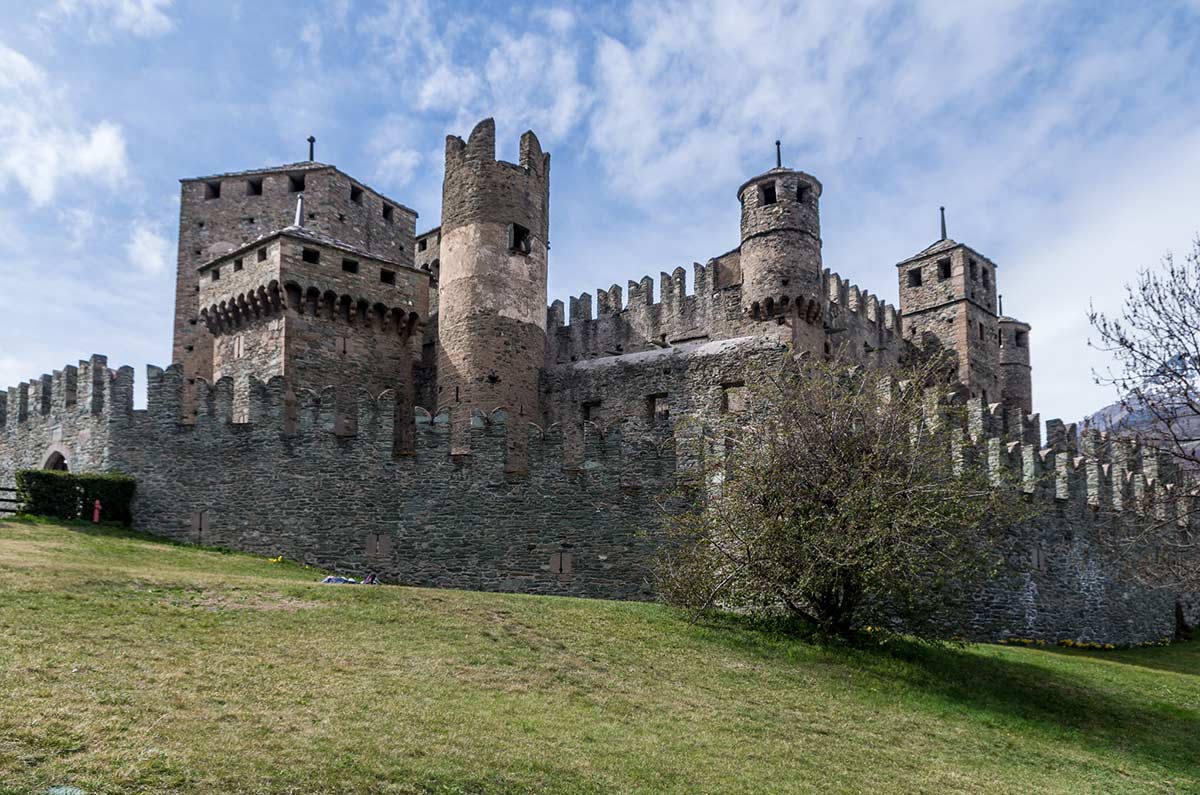
Fénis Castle is without doubt the most famous castle in the region, built from the 13th century onwards: it looks like a classic medieval castle with towers and turrets, although this structure was not built for military purposes but for residential use. Today the castle is the seat of the Museum of Valdostan Furniture, therefore it can be visited every day with entrance fee.
Ground floor
Fénis Castle has a pentagonal plan; the corners have circular turrets, except for the south-west corner, which has a massive tower, and the south corner, where the tower has a square plan. The keep is enclosed in a double wall with watchtowers connected by a patrol walkway. Access to the keep is through a square tower that had a portcullis to bar the entrance in case of danger. The visit to the ground floor includes the weapons room, the refectory for soldiers and servants, the pantry and the kitchen with a large fireplace.
First floor
We continue up to the first floor, where we see the chapel with the adjoining reception room, the chamber domini, the noble kitchen, the lords’ dining room and the justice room.
Courtyard
The tour ends in the inner courtyard, with the semicircular staircase surmounted by the remarkable fresco of St George slaying the dragon; looking up, you can admire the wooden balconies decorated with a group of wise men and prophets bearing scrolls on which proverbs and moral sentences are read in old French. Finally, the east wall is decorated with paintings of the Annunciation and St Christopher, attributed to a painter close to the school of Jaquerio and dating from around 1425-30.
Aymavilles Castle
The unique landscape of the Valle d’Aosta is dotted with numerous castles, such as that of Aymavilles, which stands on a hill in the centre of the town of the same name. The original structure is thought to date from the 13th century, although its present appearance – including the four 15th-century towers – is due to the Challant family, to whom the Savoy entrusted the fortress in 1354.
After the Challant family died out, the castle passed through the hands of various owners. Acquired in 1970 by the Autonomous Region of Valle d’Aosta, the castle is currently undergoing restoration and enhancement to make it accessible to the public.
Royal Castle of Sarre
The Royal Castle of Sarre was the residence of the Savoy family until they were exiled from Italy in 1946. Inside, on three floors, you can admire original furniture, precious objects and wonderful works of art. On the outside, however, you can appreciate the terraced landscape and the fortress tower that dominates it.
The castle is located in Lalex, on a promontory overlooking the Aosta plain above the main road to Mont Blanc, just beyond the junction for Cogne.
History
Built in 1710 by Giovanni Francesco Ferrod of Arvier on the ruins of a fortified house dating back to 1242, after various changes of ownership it was bought in 1869 by the King of Italy, Victor Emmanuel II, who renovated it and used it as his residence during his hunting expeditions in the Aosta Valley.
The royal castle of Sarre, which became part of His Majesty’s private estate, then became the headquarters used by the king for his expeditions in the valleys of Cogne, Rhêmes and Valsavarenche.
To accommodate the first king of Italy, the residence underwent some modifications, including the raising of the tower and the construction of a new stable. Inside, the rooms were completely renovated and modernised. The curator of the Royal Palace of Milan was specially commissioned to provide the furnishings, which he did by transferring furniture from other royal residences.
Vittorio Emanuele’s successor, Umberto I (1844-1900) also assigned the Alpine Castle to uses related to hunting.
In the last years of his reign, Umberto I paid particular attention to the Sarre residence, promoting its interior renovation. Among the works carried out on that occasion were important decorative campaigns for the monumental rooms, decorated with ibex and chamois trophies.
The castle was also used as a holiday residence by Queen Maria José in the years following the monarchy.
In 1989, the Aosta Valley Region bought the complex to restore it. The castle, which takes the form of a longitudinal body with a square tower in the centre, can be considered a museum of the Savoy presence in Valle d´Aosta.
Saint-Pierre Castle
Perched on the top of a mountain, the Saint-Pierre Castle looks like the perfect fairy-tale castle, with its central tower rising up in the middle of the building and the four side towers above it. Some documents found mention the castle as early as 1191, but what has come down to us is the result of numerous extensions and renovations.
Today it houses the Regional Museum of Natural Sciences.
Ussel Castle
The Ussel Castle dates back to the 14th century when it was erected by the Challant family in a strategic position at the top of the promontory. On the outside, it is a rather austere building with no decoration except for the two towers. The castle hosts numerous events and exhibitions that give the possibility to open to the public the structure that normally can only be visited from the outside along a very suggestive path.
Baraing Castle (Pont-Saint-Martin)
The Baraing Castle is perhaps the most recent in the area, built in 1883 in a neo-Gothic style, but no less prestigious and fascinating for that. It took ten years to complete the architectural work, which includes a large garden with greenhouses and fountains.
Gamba Castle (Châtillon)
Châtillon is home to the beautiful Gamba Castle, which has been converted from a prestigious historical residence dating back to the early 20th century into a museum to house the Aosta Valley Collection of Modern and Contemporary Art. In addition to the interiors, the huge park surrounding the castle is worth a visit, covering 50,000 m2 and housing 150 varieties of trees.
